
Chapter 02 of 06
Esfand smoke and harmal red, how Syrian rue has been used
Burning esfand against the evil eye, the 2,700-year-old censers of Qurayyah, harmal seed as a wool dye and what Turkey red really was. Sourced history.
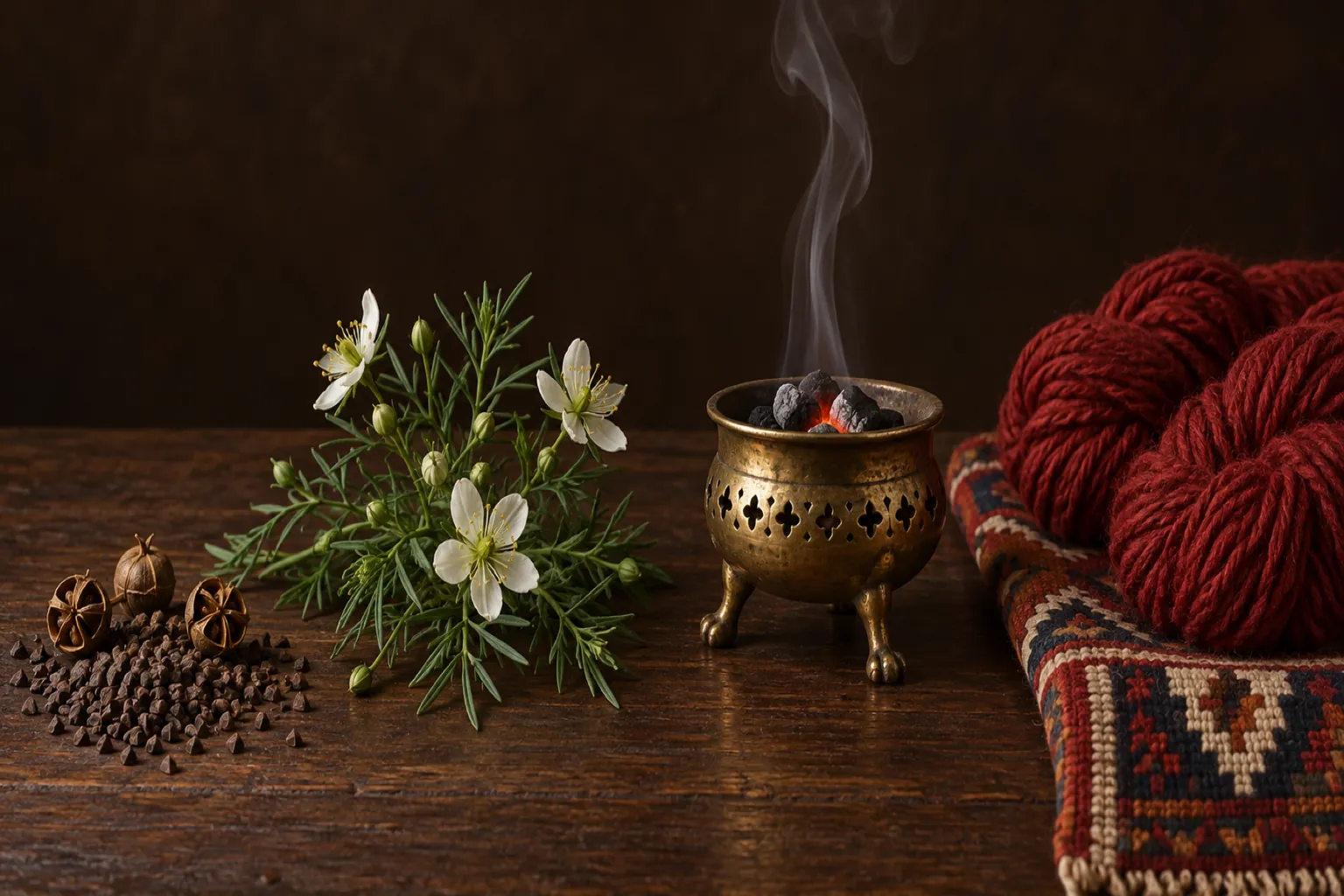
Syrian rue has been used for at least 2,700 years, mostly as something to burn and as a source of colour. In Iran and the countries around it, the seeds are still sold by weight in markets and grocery shops as esfand, to be dropped on hot coals. Elsewhere the seeds were a dye for wool. This page covers both, and what the evidence for each looks like.
The oldest evidence: censers at Qurayyah
The earliest material proof of harmal smoke comes from Qurayyah, an oasis settlement in northwest Saudi Arabia. A team from the Max Planck Institute of Geoanthropology analysed residues inside Iron Age censers excavated in houses there and found the chemical signature of Peganum harmala. Radiometric dating puts the burning at roughly 2,700 years ago, in the Middle Iron Age. The authors call it the oldest radiometrically dated evidence of harmal fumigation anywhere (Huber et al., Communications Biology, 2025; Max Planck press release).
The censers came from houses, and the authors interpret the find as domestic fumigation. That is close to how esfand is still burned in homes today.
A second find is younger and more unusual. Residue analysis of a Ptolemaic Egyptian vase decorated with the god Bes, from the 2nd century BCE, identified traces of Peganum harmala together with blue water lily and fermented fruit in a ritual liquid (Tanasi et al., Scientific Reports, 2024).
Esfand: smoke against the evil eye
In Persian culture, burning esfand is a household custom. A small handful of seeds goes onto glowing charcoal in a metal dish. The seeds pop as they heat and give off a dense, sharp-smelling smoke, and in many families the dish is circled over the heads of the people present. The best known use is protection against the evil eye, for example after someone has praised a child, at weddings and on the eve of Chaharshanbe Suri, the fire festival before Nowruz (Wikipedia: Chaharshanbe Suri).
The same custom runs through Turkey, Azerbaijan, Afghanistan and Central Asia, with local names: üzerlik in Turkish, isband in Kashmir. Dried capsules are also threaded on strings and hung in homes and cars. In Morocco, harmel is associated with protection against djinn.
What people value here is the smoke and the ritual. Nobody needs to eat anything, and nothing on this site suggests that you should.
Burning esfand at home
- Use a fireproof dish with a layer of sand and a lit charcoal disc, or the traditional small brass or steel esfand burner.
- A pinch of seeds is plenty. The popping is part of it; the smoke is dense.
- Open a window. The smoke is irritating in a small room, and what it does to the lungs has not been studied. Keep children and pets out of the smoke.
- Store the seeds out of reach of children. Seeds are the most toxic part of the plant (see risks).
Harmal as a dye
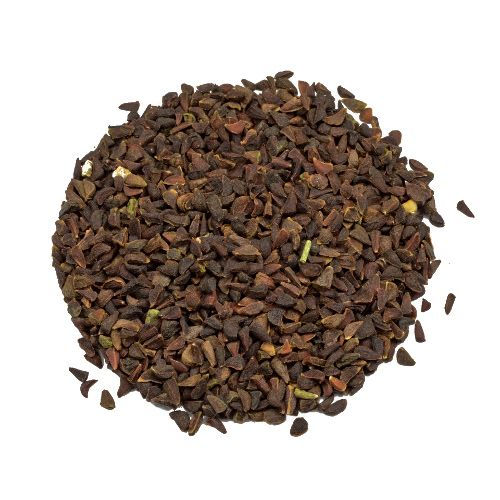
The seeds also colour wool. A 2022 study extracted colourant from harmal seed and dyed wool with it, comparing chemical mordants with plant-based ones such as pomegranate and henna extract; the plant mordants gave the better colour strength and fastness in that test (Adeel et al., Sustainability, 2022). Older botanical references report that a water extract of the seeds gives a yellow, fluorescent colour and an alcohol extract a red, and that the dye was used on carpets and wool in western Asia.
The red is the reason the plant reached North America. Sources on the New Mexico infestation agree that a farmer planted it in the 1920s to make a red dye from the seeds, though they disagree on whether he called it Turkish, Persian or Iranian red (Texas State University; US National Park Service).
What "Turkey red" actually means
You will often read that Syrian rue is the source of Turkey red. That is a mix-up. Turkey red was a famous, laborious process for dyeing cotton a bright, fast red, developed in the Ottoman Empire and brought to France in 1746. Its colour came from madder root, Rubia (Wikipedia: Turkey red). Harmal is a separate wool dye that some writers describe as an alternative to it.
Dyeing with the seeds
If you want to try it, approach it as an experimental natural dye: small skeins of wool, a scrap pot you do not use for food, and notes on what you did. The published work shows that the colour depends on how the colourant is extracted, on the mordant and on the temperature and pH of the dyebath, so expect to test. Work in a ventilated space and wear gloves; the extract contains the same alkaloids as the seed.
| Use | Part | What happens | Main precaution |
|---|---|---|---|
| Esfand | dry seeds | burned on charcoal for smoke | ventilation, keep from children |
| Hanging charm | dried capsules | strung and hung | out of reach of children |
| Wool dye | seeds | extracted, colour fixed with a mordant | dedicated pots, gloves |
| Garden plant | seeds | sown, grown as a perennial | stop it seeding outside the garden |
Choosing a bag for smoke or dye
The seeds sold for growing are the same seeds people burn or dye with. Avalon sells them in 25, 100, 250, 500 and 1000 gram bags. For occasional esfand, 25 or 100 grams lasts a long time; for dyeing, where you weigh seed against wool, the larger bags make more sense. The growing guide compares the sizes.
Choose your bag at Avalon Magic Plants
Before you keep the seeds in a house with children, read the page on risks and poisonings. For the chemistry behind the smoke, see harmine and harmaline.