
Chapter 01 of 06
Syrian rue (Peganum harmala), the plant and where it grows
What Syrian rue looks like, where Peganum harmala grows wild, why it is called rue, and why it counts as a noxious weed in parts of the United States.
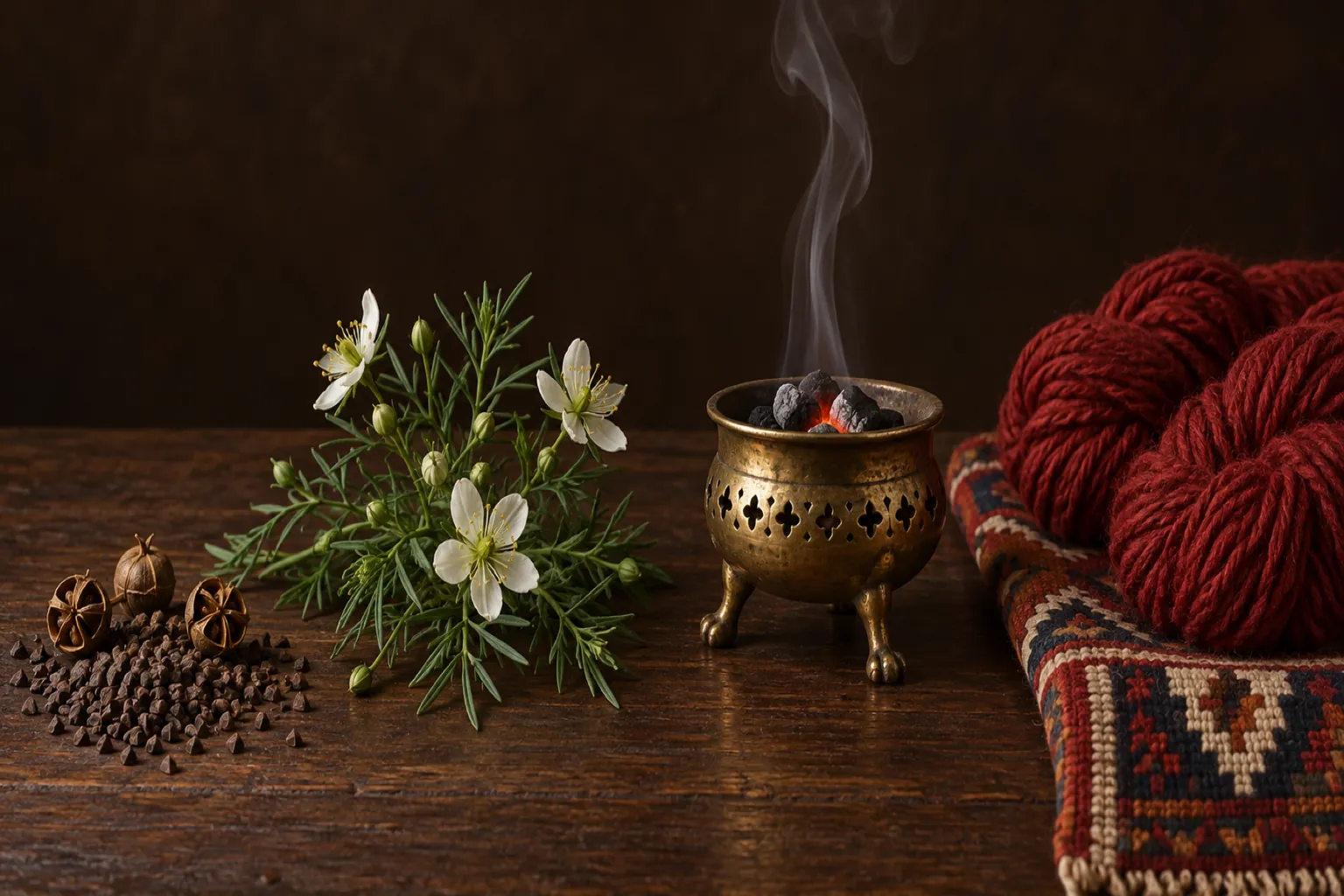
Syrian rue is Peganum harmala, a bushy perennial of dry, often salty ground that grows wild from Morocco and Spain across the Middle East and Central Asia to western Mongolia and northern China. It is known by many names: wild rue, African rue, harmal or harmel, and in Persian esfand or espand. The English name comes from a loose resemblance to garden rue (Ruta graveolens); the two plants are not related.
Current classifications place it in the small family Nitrariaceae. Older floras, and some recent papers, still list it under Zygophyllaceae, the caltrop family. That is why you will see both names in the literature.
How to recognise it
The plant forms a rounded, much-branched bush, usually 30 to 70 cm tall (Li et al., 2023). The Oregon Department of Agriculture describes plants about half a metre tall and up to 1.2 metres across (ODA profile).
- Leaves: bright green, fleshy and hairless, cut into narrow, pointed lobes.
- Flowers: white or yellowish white, with five petals, from spring into early autumn.
- Fruit: a dry, leathery, rounded capsule with two to four chambers. The ODA counts 45 to 60 seeds per capsule.
- Seeds: dark brown, angular and three-sided, about 1.8 mm long. Li and colleagues weighed them at 0.2 grams per 100 seeds, so a gram holds roughly 500.
- Smell: the seeds have a distinctive smell, and crushed stems smell unpleasant, according to the ODA.
The top growth dies back in winter. The plant survives on a woody rootstock and grows again in spring. The roots go deep: the ODA and the US National Park Service at White Sands both give depths of 20 feet (about 6 metres) in very dry soil (NPS).
Where it grows
Its natural range is large. In Europe it is native to Spain, southern Italy, Greece, Bulgaria, Ukraine and southern Russia; in Africa to Morocco, Algeria, Tunisia, Libya and Egypt; in Asia to Turkey, the Caucasus, the Levant, the Arabian Peninsula, Iran, Afghanistan, Pakistan, Kazakhstan and parts of China and Mongolia (summary on Wikipedia, which follows Kew's Plants of the World Online).
It is a plant of disturbed and degraded ground: roadsides, abandoned fields, overgrazed steppe, rubble around old settlements. It tolerates salt. In a germination study on seed from a saline desert in Xinjiang, seeds still germinated at moderate salt concentrations, and the best results, 94 percent, came with alternating day and night temperatures of 25/10 °C and 30/15 °C (Li et al., 2023).
| Feature | Syrian rue |
|---|---|
| Life form | perennial, dies back to a woody rootstock in winter |
| Height | 30 to 70 cm |
| Flowers | white, five petals, spring to early autumn |
| Seeds per capsule | about 45 to 60 |
| Seed weight | about 2 mg each, roughly 500 per gram |
| Habitat | dry, sunny, often saline or disturbed ground |
| Native range | Mediterranean to Central Asia and northern China |
A weed outside its range
In the United States the plant is not native. It was first recorded near Deming, New Mexico, in 1920 according to the ODA, where a farmer reportedly planted it to make a red dye from the seeds (Texas State University invasives database). It has since spread through southern New Mexico, west Texas and parts of Arizona, California, Nevada and Oregon.
There it is regarded as a problem plant. Oregon rates it an "A" noxious weed under quarantine, which means plants may not be brought into the state, sold or propagated (Oregon Administrative Rules 603-052-1200). Several other western states list it as a noxious weed as well. The law page has the details.
The reasons are practical. The deep roots make plants almost impossible to pull out, and the plant pushes out native saltbush and grasses on desert rangeland. It is also poisonous to grazing animals. The ODA puts the lethal amount of seeds and fruit for livestock at 0.15 percent of an animal's body weight, with young leaves less toxic and dry leaves apparently harmless.
What this means if you grow it
In a garden in the Netherlands, Britain or Germany, Syrian rue is a curiosity: a drought plant that needs sun and sharp drainage and that you have to keep in check. Cut off seed capsules you do not want before they split, and never sow it in the wild. The growing guide covers sowing, soil and winter care.
The seeds are also what people burn as esfand and use for dye, and what contains the alkaloids. Read how Syrian rue is used for the cultural side and harmine and harmaline for the chemistry.
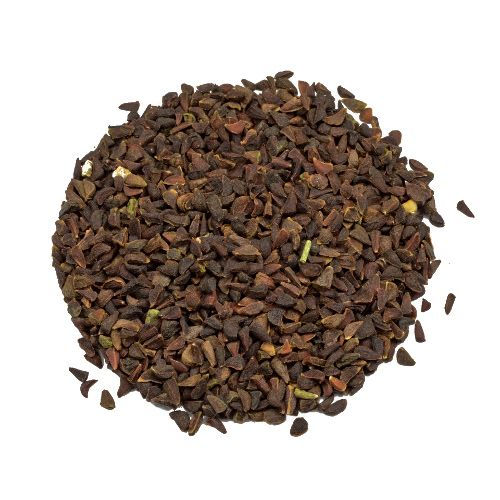
Avalon Magic Plants sells the seeds as a botanical specimen for growing and collecting. In its own description the shop states that the seeds are "strictly intended for horticultural use" and not for consumption.